
Anthropology is a science, which studies the origin and the physical, social, and cultural development and behavior of mankind. It encompasses the study of the origin of human species as well as its cultural and social structures.
Besides, Anthropology also studies the evolution of man at different ages as well as the physical and cultural diversity among humans, living at the same period of time, at various parts of the world in diverse environments. The anthropology scope in India is vast and growing. The field is interdisciplinary and can be applied to a wide range of issues, from cultural heritage to development to social justice. Click here to read career in psychology
Anthropology is the comparative study of human similarities and differences. It includes the biological and cultural history of the human species over the last four million years, the cultural patterns of people from around the world down to even those who happen to live next door to you, and the techniques and ideas people have used both to exploit and protect natural resources and the environment. Click here to read career in psychology
Unfortunately, Anthropology as a field of study still remains among one of the lesser known and less popular subjects. Mankind has yet to explore its full potential.
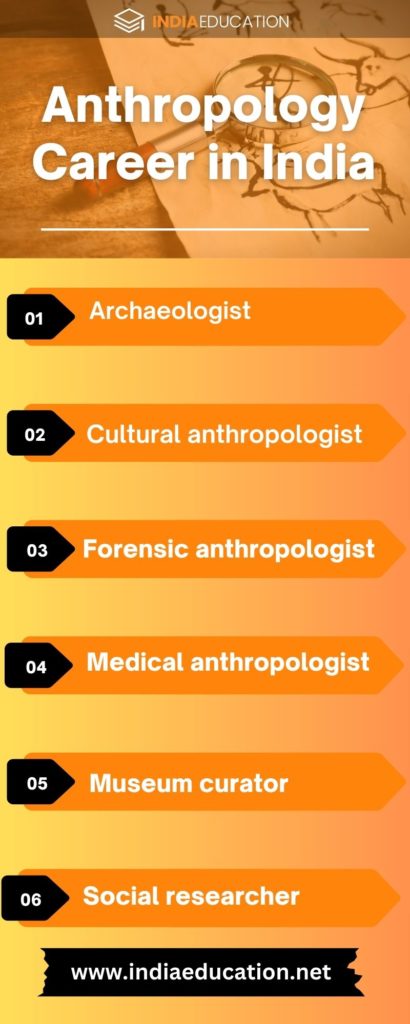
The career prospects for anthropology in India are good. The field of anthropology is diverse and there are many different career paths that you can choose from. Some of the most common anthropology career options in India include:
The eligibility criteria for anthropology in 2023 may vary depending on the university or college you are applying to. However, some general eligibility criteria include:
There are three main areas of employment for an Anthropologist, i.e., teaching, research and working in museums. Research jobs are available in organizations like Archaeological Survey of India, the Planning Commission as well as international organizations like the United Nation’s UNESCO or UNICEF also require their services.
Moreover, openings are also available for socio-cultural anthropologists with Non Governmental Organizations (NGOs) who seek their expertise in understanding of relations between industry and society.
Cultural anthropologists are particularly well suited to work in professions involving people, such as teaching, law, medicine, social work, and journalism. Archaeology majors may become cultural resource management specialists.
Museums are yet another potent source of employment. Many organizations like the ICMR, WHO and the Police Department also offer employment to anthropologists for the purpose of crime detection. Also Read What is Humanities and Social Science?
A section of the students may possibly opt for anthropologically oriented research to provide better service delivery or to assess social issues and social problems, such as in public health, education, urban planning, social welfare, and government planning, international development.
There are many anthropology jobs in India in a variety of sectors. Here are some of the most common anthropology jobs in India:
The salary for anthropology jobs in India varies depending on the experience, skills, and location of the job. However, the average anthropologist salary in india for an anthropologist in India is around INR 500,000 per year.
Since the nature of job prospects is very diverse, the salary can vary tremendously. Though, initially pay packet in this field of work is not as lucrative as other hot professions, but there is a tremendous amount of satisfaction associated with this profession.
One can expect a starting salary somewhere around Rs. 8,000-12000 per month. There also exists a stiff competition among researchers working in the field of Anthropology for grant of money from national and international funding agencies. Hence aspirants who wish to carryout research in Anthropology must be well prepared.
The following Indian universities offer B.A/B.Sc./M.A./M.Sc in Anthropology.
Vishakhapatnam – 530 003
- Andhra University
Bangalore – 560 056
- Bangalore University
Bhanja Bihar, Berhampur, Distt, Ganjam
- Berhampur University
Orissa – 760 007Dibrugarh, Assam
- Dibrugharh University
Gour Nagar, Sagar, MP
- Dr.Hari Singh Gour Vishwa Vidyalaya
Gopinath Bordili Nagar
- Guwahati University
Guwahati, AssamSrinagar, Garhwal, Uttar Pradesh
- Hemwati Nandan Bahuguna Garhwal University
Pavate Nagar, Dharwad, Karnataka
- Karnataka University
Kurukshetra, Haryana
- Kurukshetra University
Canchipur, Imphal, Manipur
- Manipur University
Nagarjuna Nagar – 522 510
- Nagarjuna University
Shillong – 793 002
- North Eastern Hill University
Jalgaon – 425 002
- North Maharashtra University
Raipur-492 010
- Pt.Ravishankar Shukla University
Pune – 411 007
- Pune University
Paliala – 147 002
- Punjab University
Sector 14, Chandigarh, Punjab
- Punjab University
Ranchi, Ranchi – 834 001
- Ranchi University
Jyoti Vihar, Burla, Orissa
- Sambalpur University
Dumka – 814 101
- Siddhu Kanhu University
Tirupati, Chittor District, AP
- Sri Venkateshwara University
Allahabad – 211 002
- University of Allahabad
Senate House, 87, College Street
- University of Calcutta
Calcutta, West BengalDelhi – 110 007
- University of Delhi
Hyderabad – 500 046
- University of Hyderabad
Mumbai – 400 001
- University of Mumbai
Mysore – 570 005
- University of Mysore
Jaipur – 302 004
- University of Rajasthan
PO Vani Vihar
- Utkal University
Bhubaneshwar Orissa-4PO Midnapore, West Bengal
- Vidya Sagar University
Hazaribagh – 825 301
- Vinoba Bhave University
PO Santiniketan-731
- Visva-Bharati
Anthropology is the study of human beings and their cultures. It is a broad field that encompasses many different subfields, such as archaeology, cultural anthropology, linguistic anthropology, biological anthropology, and forensic anthropology.
There are many different jobs that you can get with a degree in anthropology. Some common ones include archaeologist, cultural anthropologist, forensic anthropologist, medical anthropologist, museum curator, social researcher, development worker, NGO worker, and teacher.
Anthropology is a broad field with many career options. Some common jobs include archaeologist, cultural anthropologist, forensic anthropologist, medical anthropologist, museum curator, social researcher, development worker, NGO worker, and teacher.
After a BA in anthropology, you can pursue a career in research, teaching, or consulting. You can also work as an archaeologist, cultural anthropologist, forensic anthropologist, medical anthropologist, museum curator, social researcher, development worker, NGO worker, or teacher.
The salary for an anthropologist in India varies depending on the experience, skills, and location of the job. However, the average salary for an anthropologist in India is around INR 500,000 per year.
There are many exams that can be taken to pursue a career in archaeology. Some popular ones are CUET, JNUEE, IPU CET, AMU UET, and JMI UET. The eligibility criteria vary but typically require a bachelor’s degree in archaeology or a related field.
There is no one “best” stream for anthropology. The best stream for you will depend on your interests, skills, and goals.
Here are some of the most common streams for anthropology:
The difficulty of studying anthropology depends on your interests, skills, and the level of education you are pursuing. Anthropology is a broad field that encompasses many different subfields, such as archaeology, cultural anthropology, linguistic anthropology, biological anthropology, and forensic anthropology. Each of these subfields has its own unique challenges and requirements.
Anthropology is the study of human beings and their cultures. It is a broad field that encompasses many different subfields, such as archaeology, cultural anthropology, linguistic anthropology, biological anthropology, and forensic anthropology.
Here are some of the different types of anthropology:
Anthropology can help you develop critical thinking, writing, research, cultural understanding, and communication skills, which are all important for UPSC exams. It can also help you develop a deeper understanding of Indian history and culture, which are often covered in the exam.


Talk to an expert — receive personalised university options, fee details & admission support.
Thank you! One of our expert counsellors will call you within 24 hours.
You can close this window now.