
Microbiology is the branch of science that deals with the study of microorganisms, which are microscopic living organisms such as bacteria, viruses, fungi, and protozoa. It encompasses various subfields, including bacteriology (study of bacteria), virology (study of viruses), mycology (study of fungi), and parasitology (study of parasites).
Microbiologists investigate the structure, function, genetics, and behavior of microorganisms. They play a crucial role in various fields, including medicine (clinical microbiology), agriculture (agricultural microbiology), environmental science (environmental microbiology), and biotechnology (industrial microbiology).
Microbiology is essential for understanding the role of microorganisms in health and disease, biogeochemical cycles, food production, and the development of antibiotics and vaccines. It has profound implications for human health, the environment, and the advancement of scientific knowledge.
Moreover, the Microbiology course pertains to the intervention of microorganisms and their role as indispensable components of the environment. For this exact reason, the Microbiology course is a buzzword in Medicine, Genetics, Immunology and Food Science. Most of the esteemed colleges and universities in India offer undergraduate and postgraduate courses to students who wish to pursue their careers as Microbiologists. To know more about the Microbiology course details, candidates can continue reading further
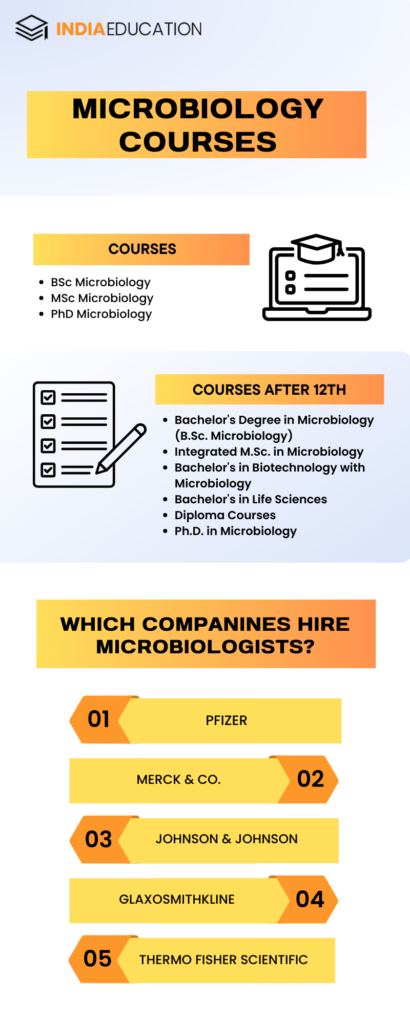
A microbiology course can help you learn about the relationship between microorganisms and their surroundings, as well as how these microorganisms affect people. Microbiology is a vast field with many subfields, so you can choose to focus on a specific area of interest. Microbiology courses typically cover the diversity and activity of microorganisms in their environment, as well as how they can cause disease and how to develop treatments for these diseases.
Here are some of the key points of microbiology courses:
| Particulars | Details |
|---|---|
|
Course Level |
UG & PG
|
|
Duration |
2-3 years
|
|
Course fee |
Up to INR 10 lakh |
|
Entrance Exams |
NEET PG, INI CET |
|
Popular Colleges |
Alagappa University, Aligarh Muslim University, Bharathiar University, Calcutta University |
|
Average Salary |
Up to INR 20 lakh |
|
Top Recruiters |
Food Industry, Beverage Industry, Clinical Diagnostic Laboratories, Environmental Agencies, Agriculture Industry, Hospitals, Pharmaceutical Industries |
|
Job Profiles |
Bacteriologist, Mycologist, Parasitologist, Virologist, etc.
|
BSc Microbiology:
BSc Microbiology: This is a 3-year undergraduate degree program that provides students with a foundation in the principles of microbiology. Students typically take courses on the structure and function of microorganisms, the ecology of microorganisms, the role of microorganisms in human health, and the use of microorganisms in biotechnology. The fees structure of BSC Microbiology is around INR 50,000 – INR 200,000 per annum.
BSc Microbiology Courses:
MSc Microbiology:
MSc Microbiology: This is a 2-year postgraduate degree program that builds on the knowledge and skills acquired in a MSc Microbiology program. Students typically take courses on advanced topics in microbiology, such as molecular biology, virology, and immunology. The fees structure of BSC Microbiology is around INR 60,000 – INR 250,000 per annum.
MSc Microbiology Courses:
PhD Microbiology:
PhD Microbiology: This is a 4-6-year research degree program that prepares students for a career in research. Students typically conduct original research on a topic in microbiology and write a dissertation on their findings. The fees structure of PhD Microbiology is around INR 100,000 – INR 400,000 per annum.
PhD Microbiology Courses:
Once you finish your 12th grade in India, you have a few options if you want to study microbiology. Here’s what you can do:
Microbiology is the study of tiny living things like germs and bacteria. In India, if you study microbiology, you can have some exciting career options. Here’s what you can do:
| Exam | Fees | Minimum GPA |
|---|---|---|
|
Common University Entrance Test (CUET) |
INR 1000 |
3.0 |
|
Aligarh Muslim University Entrance Examination (AMUEEE) |
INR 1000 |
3.0 |
|
Indian Institutes of Science Education and Research (IISER) Integrated Admission Test (IISER IAT) |
INR 1000 |
3.0 |
|
Birla Institute of Technology and Science Admission Test (BITSAT) |
INR 2500 |
3.0 |
|
National Eligibility cum Entrance Screening Test (NEET) |
INR 1400 |
N/A |
The Microbiology admission is primarily based on a merit list. Nonetheless, some universities prefer to use entrance examinations as part of the admissions process. Students seeking admission to the Microbiology course must meet the following basic qualifying criteria:
Microbiology UG Eligibility Criteria:
Microbiology PG Eligibility Criteria:
Microbilogy UG Syllabus:
Semester 1
Semester 2
Semester 3
Semester 4
Microbilogy PG Syllabus:
Semester 1
Semester 2
Semester 3
Semester 4
The following institutes/universities in India are offering bachelors or master level courses in Microbiology.
| Name of University | Course | Eligibility |
| EASTERN REGION | ||
| Manipur University | B.Sc. | Pre- Univ.(2 years) |
| Canchipur Imphal 795003 | M.Sc | B.Sc. |
| North Eastern Hill University, Loser Lachauniere Shillong 793001 | M.Sc. | A Honours degree |
| Univ. of Calcutta, College Street, Calcutta 700073 | M.Sc. | B.Sc. exam |
| Univ. of Kalyani, PO Kalyani, Distt. Nadia 741235 | M.Sc. | B.Sc. (Hons) degree. |
| Rajendra Agricultural University, Samastipur 848125 | M.Sc. | B.Sc. |
| Orissa University of Agriculture and Technology Bhubaneshwar 751003 | B.Sc. (Pass/Hons) | Inter 10+2 with 40% – 50% in the chosen subject |
| NORTHERN REGION | ||
| Chitrakoot Gramodaya Vishwavidyalaya Distt. Satna 210204 MOP | B.Sc. | +2 Sc. |
| Devi Ahilya Vishwavidyalaya, 16D, RN Tagore Marg, Indore 452001 (MP) | M.Sc. | B.Sc. exams |
| Pt. Ravishankar Shukla UNiversity, Rajpur 492010 (MP) | M.Sc. Clinical Biochem. | B.Sc. |
| Rani Durgavati Vishwavidyalaya, Jabalpur 482001 | M.Sc. | B.Sc. |
| Jiwaji Univeristy, Vidya Vihar, Gwalior 474011 | M.Sc. | B.Sc. exams |
| Narendra Dev University of Agriculture, Faizabad 224229 | B.Sc. | Inter |
| Rohilkhand Univ. Bareilly, U.P. | B.Sc. | Inter |
| Aligarh Muslim University, Aligarh 202002 | M.Sc. B.Sc. | B.Sc. with 50% XII |
| Banaras Hindu Univeristy, Varanasi 221005 | M.Sc. | B.Sc. Hons with 45% |
| University of Lucknow, Lucknow 226007 | M.Sc. | B.Sc. |
| University of Delhi Delhi 110007 | B.Sc. Hons M.Sc. | (Class XII) B.Sc. |
| All India Instt. of Med. Sciences, Ansari Nagar, Delhi 110029 | M.Sc. | B.Sc. Hons |
| Jamia Hamdard, New Delhi – 62 | M.Sc. | B.Sc. |
| Kurukshetra Univeristy, Kurukshetra 132119 | B.Sc. Hons | 10+2 |
| Haryana Agricultural Univeristy, Hisar 125004 | M.Sc. | Graduate level 53% agg. |
| National Dairy Research Instt. Karnal 132001 | M.Sc. | Bachelor’s degree |
| Guru Nanak Dev University, Amritsar 143005 | B.Sc. M.Sc. | 10+2 exam with 40% B.Sc. with 50% |
| Punjab Agricultural Univ. Ludhiana 141004 | B.Sc. | Higher Secondary |
| Punjab Univ., Sector 14, Chandigarh 160014 | B.Sc. M.Sc. | 10+2 B.Sc. |
| University of Kashmir, Hazratbal, Srinagar 190006 | M.Sc. | B.Sc. |
| Himancal Pradesh Krishi Vishwavidyalaya, Palampur 176062 | M.Sc. | B.Sc. |
| WESTERN REGION | ||
| Sardar Patel University Vidhya Nagar Gujarat 388120 | B.Sc. | 12 yrs Higher Sec. with Science |
| Gujarat University, Navrang Pura, Ahmedabad 380009 | M.Sc. | B.Sc. |
| University of Bombay, M.G.RoadFort, Mumbai 400032 | B.Sc. M.Sc. | Higher Sec. B.Sc. |
| Marathwada University, Aurangabad 431004 | B.Sc. M.Sc. | Higher Sec. B.Sc. exam of their Univ or an equivalent. |
| Northern Maharashtra University, Jalgaon 425002 | M.Sc. | B.Sc. |
| MS University of Baroda, Vadodara 3900002, Gujarat | M.Sc. | B.Sc. |
| Nagpur University, exam Near Maharaj Bagh, M.G.Marg, Nagpur 440001 | M.Sc. | B.Sc. |
| Shivaji University, Vidhyanagar, Kolhapur 4160004 | M.Sc. B.Sc. | B.Sc. Higher Secondary |
| Goa University, PO Santa Cruz Taleigao Plateau Goa 403002 | M.Sc. | B.Sc. exam in which 100 marks of each years is taken |
| Dr. BR Ambedkar Marathwada Univ. Aurangabad 431004 | B.Sc. M.Sc. | Higher Sc. B.Sc. |
| SOUTHERN REGION | ||
| Kakatiya University Vidyaranyaupuri Warangai 506009 | B.Sc. | Intermediate |
| Andhra Univ., Vishakapatnam 530003 | M.Sc. | B.Sc. |
| Osmania University, Administrative Bldg., Hyderabad 400007 | M.Sc. | B.Sc. with 45% |
| Shri Krishnadevaraya University, Sri Venkateswarapuram, Anantapur 515003 | M.Sc. | B.Sc. |
| Sri Venkateswara University, Tirupati 517502 Chittoor Distt., A.P. | M.Sc. | B.Sc. |
| Avinashilingam Instt. for Home Sc. & Higher Education for Women, Coimbatore 641043 | B.Sc. M.Sc. | HSC with major for Home Sc. and Higher subject Bio. – chem. B.Sc. with concerned subjects. |
| Madurai Kamraj University, Palkalai, Madurai | M.Sc. | B.Sc. with 55% |
| Mahatma Gandhi University, Kottayam 686560 | M.Sc. | B.Sc. |
| University of Madras, Centenary Bldgs., Chepauk, Chennai | B.Sc. M.Sc. | 12 yrs of Higher Sec. Bachelor’s deg. in relevant Sc. subject |
| Bharathidasan Palkalaiperun Tiruchirapalli | M.Sc. | B.Sc. in main subject |
| Bharathiar University, Maruthamalai Road, Coimbatore 641046 | B.Sc. M.Sc. | 12 yrs. B.Sc. |
| Univ. of Mysore Crawford Hall Karya Soudha, Mysore 570005 | B.Sc. M.Sc. | 2 yrs Pre-Univ. B.Sc. |
| Karnataka Univ., Pavate Nagar, Dharwad 580003 | M.Sc. | B.Sc. with 50% admission test |
| University of Kerala, University PO Thiruvanthapuram, Kerala 695034 | M.Sc. | B.Sc. |
| Annamalai Univ., PO Annamalainagar | ||
| Name of University | Course | Eligibility |
| EASTERN REGION | ||
| Manipur University, Univ Canchipur Imphal 795003 | B.Sc. | Pre |
| Orissa Univeristy of Agriculture & Tech. Bhubaneshwar 751003 | B.Sc. (P) (Hons) M.Sc. | Inter or +2 Sc. B.Sc. |
| NORTHERN REGION | ||
| Madhya Pradesh Barkatullah Vishwavidyalaya, Hoshangabad Road, Bhopal 462026 | M.Sc. | B.Sc |
| Rani Durgavati Vishwavidyalaya, Pachpedi, Jabalpur 482001 | M.Sc. | B.Sc |
| Jiwaji Unviersity,Vidya Vihar, Gwalior 474011 | M.Sc. | B.Sc |
| Pt. Ravi Shankar Shukla Univ., Raipur 492010 | M.Sc. | B.Sc |
| Himanchal Pradesh Himachal Pradesh Univ. Summer Hill 171005 | M.Sc. | B.Sc |
| Uttar Pradesh GB Pant Univ. of Agriculture and Tech., Pantnagar 263145 | M.Sc. | B.Sc |
| Gurukula Kangri Vishwavidyalaya, Gurukula Kangri Hardwar 249404 | M.Sc. B.Sc. | B.Sc 10+2 |
| Chaudhary Charan Singh University, Meerut 250005 | B.Sc. M.Sc. | 10+2 B.Sc |
| Delhi University of Delhi Delhi 110007 | M.Sc. B.Sc. | B.Sc 10+2 |
| Haryana Kurkshetra University, Kurukshetra 132119 | M.Sc. | B.Sc |
| Haryana Agricultural University, Hisar 125004 | M.Sc. | Graduate with 53% |
| Maharishi Dayanand Univ., Rohtak 124001 | M.Sc. | B.Sc |
| Punjab Guru Nanak Dev Univ., Amritsar | B.Sc. M.Sc. | 10+2 with 40% B.Sc. with 50% |
| Punjab Agricultural University, Ludhiana 141004 | M.Sc. B.Sc | OGPA of 2.70 at appropriate degree. |
| Punjab University, Sector – 14, Chandigarh | B.Sc. M.Sc. | 10+2 B.Sc |
| WESTERN REGION | ||
| Gujarat Sardar Pateluniversity, P.B.No. 10, Vallab Vidhyanagar 388120 | B.Sc. M.Sc. | 12 yrs of higher Sec. with Sc. B.Sc. |
| Saurashtra University, University Campus, Kalvad Road, Rajkot 360005 | B.Sc. (spl) | 12 yrs Higher Sec. |
| South Gujarat university,P.B. 49, Udhna Magdalla Rd, Surat 395007 | B.Sc. | Higher Sec with Science |
| Maharaja Sayajirao University of Baroda, Vadodara 390002 | M.Sc. | B.Sc. |
| Govind Ballabh Pant University of Agril. & Technology, | M.Sc. | B.Sc. degree . |
| Gujarat Universtiy, Navrangpura Ahmedabad 380009 | B.Sc. M.Sc. | 10+2 B.Sc |
| Maharashtra University of Mumbai M.G.Road Fort, Mumbai 400032 | B.Sc. M.Sc. | XII B.Sc. degree |
| Marathwada Univ., Aurangabad 431004 | B.Sc. M.Sc. | 12 yrs hr sec or Equivalent B.Sc.of the univ./equivalent |
| University of Poona, Ganeshkhind, Pune 411007 | B.Sc. M.Sc. | 12 yrs Hr. Sec. Science B.Sc. |
| Shivaji University Vidya nagar, Kolhapur 416004 | M.Sc. | B.Sc. |
| Nagpur University MG Marg Nagpur 440001 | M.Sc. | B.Sc. |
| Swami Ramanand Teerth Marathwada University, Vishnupuri, Nanded 431603 | M.Sc. B.Sc. | B.Sc. 10+2 |
| North maharashtra univ., Umavinagar, Jalgaon 425002 | M.Sc. | B.Sc. |
| Dr. BR Ambedkar Marathwada Univ., Aurangabad 431004 | M.Sc. B.Sc. | B.Sc. 10+2 |
| Goa Goa University, PO Santa Cruz Taleigao Plateau Goa 403002 | B.Sc. M.Sc. | XII B.Sc. with 7 units of 100 marks in each year. |
| SOUTHERN REGION | ||
| Andhra Pradesh Osmaina University, Administrative Bldg. Hyderbad 500007 | B.Sc. M.Sc. | Inter with 40% B.Sc. |
| Sri Krishnadevaraya University, Sriu Venkateswarapuram Anantapur 515003 | M.Sc. | B.Sc. |
| Ari Padmavati Mahila Viswavidyalayam, Tirupati 517502 Chittoor Distt. | M.Sc. | B.Sc. |
| Kalkatiya University Warangal 506009 | B.Sc. M.Sc. | 10+2 B.Sc. |
| Karnataka Gulbarga University, Unanaganga Gulbarga 585106 | B.Sc. M.Sc. | 12 yr pre univ. Hr. Sec B.Sc. |
| University of Mysore, Crawford Hall Mysore 570005 | B.Sc. M.Sc. | 10+2 B.Sc. |
| Karnataka university, Pavate Nagar, dharwad 580003 | B.Sc. | 10+2 with Sc. sub |
| Mangalore University, Mangalagangotri 574199 | B.Sc. | 10+2 |
| Tamil Nadu University of Madras Centenary Dldg., Chepauk, Chennai 600005 | B.Sc. M.Sc. | 12 yr Bachelor’s degree |
| Manonmaniam Sundaram Univ., Abishekapatti, Tirunelveli 627018 | M.Sc. | B.Sc. |
| Bhartidasan Univ., Tiruchirapalli 620024 | M.Sc. | B.Sc. |
| Bharathiar University, coimbatore 641046 | B.Sc. M.Sc. | 10+2 B.Sc. |
| Kerala Mahatma Gandhi Univ., Kottayam, 686560 | M.Sc. | B.Sc. |
| Job Profiles | Job Description | Average Annual Salary (in INR LPA) |
|---|---|---|
|
Microbiologist |
Conducts research on microorganisms, such as bacteria, viruses, and fungi. Analyzes samples to identify and diagnose microorganisms. Develops methods to control and prevent the growth of microorganisms. |
2.5 – 6.0 LPA
|
|
Quality Assurance Microbiologist |
Ensures the quality of products and services by testing for the presence of microorganisms. Develops and implements quality control procedures. Inspects and evaluates production processes. |
3.0 – 7.0 LPA
|
|
Clinical Microbiologist |
Identifies and diagnoses microorganisms that cause human diseases. Performs laboratory tests to detect and measure the presence of microorganisms. Advises physicians on the treatment of infectious diseases. |
4.0 – 8.0 LPA
|
|
Environmental Microbiologist |
Studies the role of microorganisms in the environment. Conducts research on the impact of pollution and climate change on microorganisms. Develops methods to control and prevent the spread of microorganisms in the environment. |
3.5 – 7.5 LPA
|
|
Food Microbiologist |
Ensures the safety of food by testing for the presence of microorganisms. Develops and implements food safety procedures. Inspects and evaluates food production facilities. |
3.0 – 6.0 LPA
|
|
Pharmaceutical Microbiologist |
Studies the use of microorganisms in the production of pharmaceuticals. Develops and tests new antibiotics and vaccines. Inspects and evaluates pharmaceutical manufacturing facilities. |
4.0 – 8.0 LPA
|
|
Research Scientist |
Conducts research on microorganisms in a variety of fields, such as medicine, agriculture, and biotechnology. Develops new methods and technologies for the study of microorganisms. Publishes research findings in scientific journals. |
5.0 – 10.0 LPA
|
|
Lecturer |
Teaches microbiology at the university level. Conducts research and publishes research findings. Supervises students in laboratory research. |
4.0 – 8.0 LPA
|
|
Consultant Microbiologist |
Provides advice and expertise on a variety of microbiology-related issues to businesses, government agencies, and other organizations. Develops and implements microbiology-related projects. |
6.0 – 12.0 LPA
|
Microbiology is a highly sought-after discipline of biology with several opportunities in both the public and business sectors. More microbiologists are needed to contribute to clinical research, solve problems in industrial manufacturing processes, and so forth. The scope of Microbiology courses has expanded dramatically due to a movement towards research and development as well as technological innovation. Microbiologists are in great demand in the following industries:
Microbiology courses deal with the study of all microscopic living organisms. They include bacteria, viruses, fungi, protozoa, and algae. Patient learners have a good career in microbiology. Because in life-science degrees students must keep going till PhD to get a good job.
MBZC stands for Microbiology, Zoology, and Chemistry. It is a 3-year undergraduate degree program that provides students with a foundation in the principles of microbiology, zoology, and chemistry. Students learn about the structure, function, and genetics of microorganisms, as well as the taxonomy, morphology, and ecology of animals and plants. They also learn about the basic principles of chemistry, including atomic structure, bonding, and reaction mechanisms.
NEET is for MBBS and BDS courses. The basic eligibility criteria for BSc Microbiology is that the candidate should have passed class 12 with PCB and have secured more than 50% marks. But, the required percentage of marks varies from college to college.
The course is best suited for those students who wish to make a career in research related to the evolution of microorganisms and their impact. Also, you will get to learn about the different aspects of biochemistry, physiology and genetics of microorganisms.
There are many different types of microbiology courses available, but some of the most common ones include:
Article Updates:
08/09/2023: General Update
08/09/2023: Interlinking
08/09/2023: FAQS Update
08/09/2023: Infographic Update


Talk to an expert — receive personalised university options, fee details & admission support.
Thank you! One of our expert counsellors will call you within 24 hours.
You can close this window now.