Before jumping to the conclusion that a Masters in Business Administration (MBA) is the right path for you, stop and ask yourself why. The hunky-dory vision of life after MBA may not be so easy after all. Not every management graduate receives a cushy job and dream salary package. You must have your goals in place to be able to establish a solid and successful career after an MBA.
The usual reasons for doing an MBA these days:
It earns you more money
It gives you a promotion in your job
It helps you quit a job that sucks
But in order to pursue an MBA and to feel truly satisfied by doing so, you must take a more cognitive view:
Why pursue an MBA
To launch a progressive career
To make a shift in career, if you already are an experienced professional
To nurture an innovative outlook
To network with the best in the market
To add a brand value to yourself
To enhance personal growth
To start a business/ start-up/ turn entrepreneur
To move to another location
Top jobs after MBA
Once you know why you want an MBA degree, you should be prepared with a knowledge base of jobs that require this degree. Based on that, you may nurture your career interest. Client relations, consulting, business planning, resource or system analysis may be a part of your job profile, but let’s take a more specific view of the job opportunities after an MBA:
Banking & Finance: This includes security & investment analysis and portfolio management. These jobs, available with banks, security firms, insurance companies, and various financial organizations, require a professional to make right choices about investments. Related job profiles are in Corporate Treasury, Business Operations and Credit Analysis. Such jobs are typically offered by companies such as Goldman Sachs, J.P. Morgan, Nomura, RBS, Barclays etc. Other job opportunities in banks are for Commercial Banking, Liabilities Product Management, Cards Management, Transaction Banking, Corporate Banking, Compliance, Wholesale Risk, Credit Risk, Relationship Management and Treasury. Banks like ICICI Bank, Yes Bank, Kotak Bank, Axis Bank, State Bank of India, HDFC Bank and RBL hire MBA graduates for such roles.
Information System Management: This requires a more technology-focused candidate, day someone with an MBA in Information Systems. Such candidates identify fresh and up-to-date technologies to serve an organization better. They provide a thorough cost analysis for use of the right technology while working with financial and managerial departments.
Investment Banking:This is a job in demand. Companies that hire for this role include SBI Capital Markets, Motilal Oswal & Bank of America Continuum among many others. The right candidate functions as an underwriter. He/she has to connect investors to fund-needing organizations. The candidate must have the acumen to analyze what fits best for the client. They deal with acquisitions and mergers as well as clients. Other job profiles include those in Treasury, Securities and Investment Management.
These being the top three options, there are MBA job opportunities for a graduate:
Management Consulting: If you are a problem solver, this is the job that suits you best. A management consultant specifically solves organizational issues, while embracing fresh ideas and new methods of problem-solving. Firms that hire for such roles include Cognizant Business Consulting, Bain (BCC), KPMG, PwC, Infosys Management Consulting, Michael Page, Deloitte, PeopleStrong, Cartesian Consulting & many more.
Private Equity: Just like investment banking, your investment acumen comes into action in a private equity job profile. Companies that recruit are Religare, Magma Fincorp, DE Shaw, Indiabulls Housing Finance, Kotak Life, Angel Broking, ICICI Prudential Asset Management, Bajaj Finserv, Kotak Wealth Management, JPMorgan Chase, Axis Securities, Fidelity Investments, Fullerton etc.
Data analytics:With the digital revolution, making sense out of “big data” is becoming increasingly important for all kinds of businesses be it banking, retail, e-commerce or management. As a result many business schools have now started offering data analytics as an important part of their MBA programs. Companies like Fractal Analytics, LatentView Analytics hire MBA graduates as data scientists or data analysts. (Also read:Colleges in India offering Business Analytics programs)
Entrepreneurship: An MBA enhances your ability to be an entrepreneur. Be a fresh graduate or an experienced professional, choosing your career becomes easy with an MBA in your kitty. (Also read:10 Business Schools in India teaching Entrepreneurship)
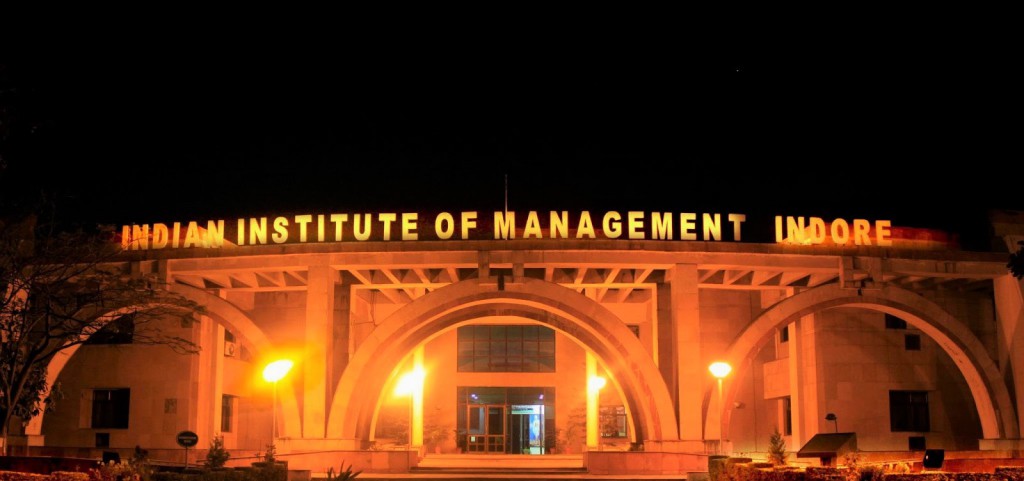
The beautiful entrance to the Indian Institute of Management, Indore; Image Courtesy: byjus.com
Pay package for MBA graduates from top B-schools
There has been only a marginal rise in the pay package as reported by the top B-schools in India. Click on each college to know more about their placements. Know the Jobs after IIM, The average pay scale has been illustrated in the table below:
B-School : IIM Indore
Average Salary (INR) :
15.67 lakh per annum
Top Recruiting Areas : Finance, Marketing & Sales
B-School : IIM Shillong
Average Salary (INR) :
14 lakh per annum
Top Recruiting Areas : Consulting, IT/ Analytics
B-School : IIM Ranchi
Average Salary (INR) :
15.14 lakh per annum
Top Recruiting Areas : Marketing & Sales
B-School : IIM Trichy
Average Salary (INR) :
13.01 lakh per annum
Top Recruiting Areas : Marketing
B-School : IIM Udaipur
Average Salary (INR) :
12.91 lakh per annum
Top Recruiting Areas : Marketing & Sales
B-School : IIM Raipur
Average Salary (INR) :
12.51 lakh per annum
Top Recruiting Areas : Marketing & Sales
B-School : IIFT, Delhi
Average Salary (INR) :
18.01 lakh per annum
Top Recruiting Areas : Marketing, Sales
B-School : FMS, Delhi
Average Salary (INR) :
20.5 lakh per annum
Top Recruiting Areas : Consulting, General Management
B-School : XLRI Jamshedpur
Average Salary (INR) :
18.5 lakh per annum
Top Recruiting Areas : Finance
B-School : NMIMS Mumbai
Average Salary (INR) :
17.09 lakh per annum
Top Recruiting Areas : BFSI
B-School : JBIMS Mumbai
Average Salary (INR) :
18.13 lakh per annum
Top Recruiting Areas : BFSI